One-Sentence Answer
AI agent skills transform general assistants into specialized tools that remember your workflows, learn from corrections, and compound value over time — making the hundredth task faster than the first.
The Problem: Why Your AI Feels Dumb on Monday
You spend Tuesday teaching your AI assistant how to format your weekly report. By next Tuesday, it has forgotten everything and you start over.
This is the fundamental limitation of traditional AI chat interfaces: they have no persistent memory of your workflows, preferences, or domain knowledge. Every conversation begins at zero.
The solution emerging across AI platforms in 2026 is skills — reusable, persistent workflows that teach your AI to specialize in your specific tasks.
What Are AI Agent Skills?
An AI skill is more than a prompt template. It's a complete workflow definition that includes:
- Context: Your specific project details, conventions, and constraints
- Tools: Which APIs, databases, or systems to use
- Procedures: Step-by-step logic for complex tasks
- Validation: Quality checks and error handling
- Memory: Lessons learned from past executions
When you ask an AI with skills to "generate my weekly report," it doesn't just produce text. It knows your data sources, formatting preferences, validation rules, and delivery channels — because it learned them from doing this task forty times before.
This is the difference between a general assistant (who needs training every time) and a specialized colleague (who has institutional memory).
How Different Platforms Implement Skills
The skill concept exists across AI platforms, but with dramatically different capabilities:
| Platform | Implementation | Persistence | Tool Access | Sharing | |----------|---------------|-------------|-------------|---------| | ChatGPT GPTs | Custom instructions + knowledge files | Per-conversation | Limited (code interpreter, web) | Public GPT store | | Claude Projects | Project-level context documents | Cross-session within project | Claude's built-in tools | Manual sharing | | Hermes Agent Skills | Structured workflow documents | Permanent, cross-session | Full system access (terminal, APIs, files, messaging) | Skills hub + manual | | GitHub Copilot Workspaces | Repository context | Per-repository | Git + IDE integration | Organization-level |
The key differentiator is persistence and capability. ChatGPT GPTs reset every conversation. Claude Projects remember context but can't execute system commands. Hermes skills persist forever and have full tool access.
The Three Levels of AI Specialization
Level 1: Prompt Templates (Static)
The simplest form: you save a prompt and reuse it.
Example: "Write a LinkedIn post about {topic} in my professional tone."
Limitation: No memory, no learning, no tool integration. You must manually adjust context every time.
Platforms: ChatGPT bookmarks, Claude artifacts, any chat interface.
Level 2: Project Context (Persistent but Passive)
You provide background documents that persist across sessions.
Example: Upload your company's style guide, brand assets, and previous content to a Claude Project. Every conversation starts with this context.
Limitation: The AI has context but no procedural knowledge. It knows your brand voice but doesn't know your publishing workflow.
Platforms: Claude Projects, ChatGPT memory, Copilot workspace files.
Level 3: Active Skills (Persistent + Procedural + Tool-Aware)
The AI has context, procedures, tool access, and learns from execution.
Example: A "blog deployment" skill that:
- Reads your article from a specific directory
- Validates frontmatter against your schema
- Generates cover images with specific style parameters
- Commits to git with your conventions
- Pushes to trigger deployment
- Verifies the build succeeded
- Posts to your social channels
The skill was created by doing this once, then saved. The hundredth deployment is faster and more reliable than the first because the skill accumulated error-handling patterns.
Platforms: Hermes Agent, some enterprise AI platforms.
Why Skill Ecosystems Matter
The shift from general AI to specialized AI mirrors the evolution of software itself.
In the 1990s, we had general-purpose tools (Word, Excel) that could do anything but required manual expertise. Then came specialized software (Salesforce, Figma, GitHub) that encoded domain knowledge.
AI is following the same path:
2023-2024: General assistants (ChatGPT, Claude) — powerful but require prompting expertise
2025-2026: Specialized agents with skills — domain expertise encoded in reusable workflows
2027+: Skill marketplaces where you install pre-built workflows like npm packages
The practical implication: your competitive advantage is no longer access to AI, but the quality of your skill library.
Two developers using the same AI model will have vastly different productivity if one has spent six months building a skill library for their specific stack, deployment process, and code style.
Real-World Examples of AI Skills in Action
Content Publishing Pipeline
A content creator's skill might:
- Research trending topics in their niche using specific APIs
- Generate article drafts matching their voice and structure
- Create cover images with their brand colors
- Optimize for SEO using their keyword strategy
- Schedule posts across platforms via APIs
- Track performance and adjust future content
After six months, the skill knows which topics perform, what tone resonates, and which platforms convert — knowledge that compounds with every article.
Code Review Automation
A developer's skill might:
- Pull the latest PR from GitHub
- Run security scans with specific tools
- Check code style against team conventions
- Generate inline comments for issues found
- Create a summary report
- Post to Slack with the right mentions
The skill learns which issues matter most to the team, which patterns cause bugs, and how to phrase feedback that gets addressed.
Financial Reporting
A business owner's skill might:
- Pull data from accounting software
- Generate reports in their specific format
- Highlight anomalies based on historical patterns
- Create executive summaries
- Email stakeholders with appropriate context
The skill accumulates knowledge about seasonal patterns, vendor relationships, and which metrics matter most.
The Skill Creation Process
Creating effective skills follows a pattern:
Step 1: Do the task manually with the AI, providing detailed instructions and corrections.
Step 2: Identify the workflow — what steps repeat, what context is needed, what tools are involved.
Step 3: Save as a skill — most platforms let you explicitly save the workflow for reuse.
Step 4: Refine over time — the skill improves as you use it, incorporating error handling and optimizations.
In Hermes Agent, this looks like:
You: "Deploy the website"
AI: [executes 15 steps, asks for clarification on edge cases]
You: "Save this as a skill"
AI: [creates deploy-website.md with full procedure]
Next time you say "deploy the website," the skill loads automatically and the AI executes without questions.
Limitations and Risks
Skills are powerful but not magic:
Context drift: Skills assume your environment stays relatively stable. If you change deployment platforms, the skill breaks and needs updating.
Over-specialization: A skill optimized for one workflow may fail on edge cases. General AI remains better for novel tasks.
Skill maintenance: Like code, skills require updates when underlying tools change. An abandoned skill becomes a liability.
Security: Skills with tool access can be dangerous if shared carelessly. A skill that deploys to production should not be published to a public marketplace.
The Future: Skill Composition and Collaboration
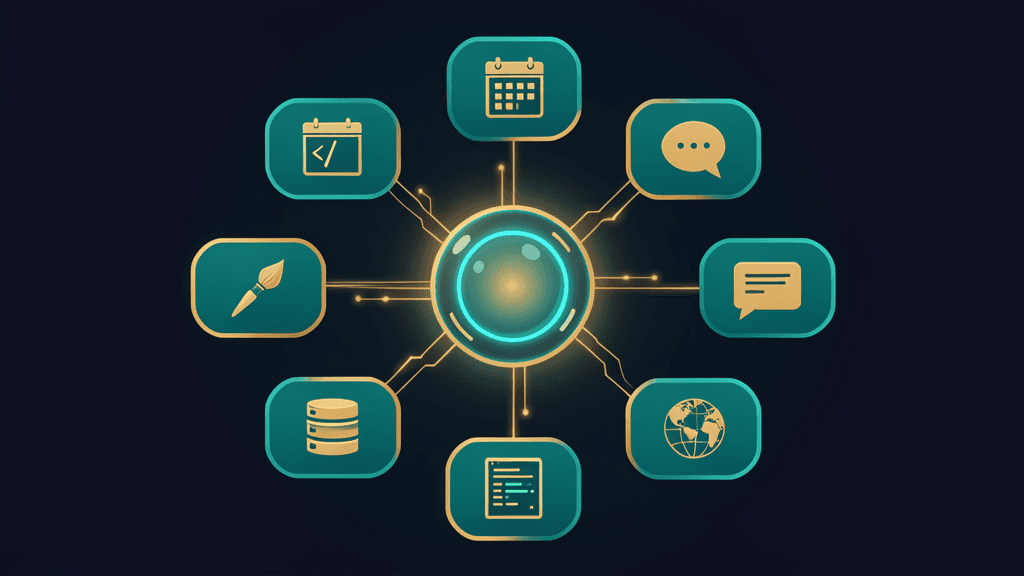
The next evolution is skill composition — combining multiple skills into complex workflows.
Imagine:
- A "research" skill that gathers data
- A "writing" skill that drafts content
- A "design" skill that creates visuals
- A "publishing" skill that distributes content
Orchestrated together, these form a complete content pipeline that runs with a single command.
We're also seeing skill collaboration — sharing skills between team members so everyone benefits from institutional knowledge. When your senior developer creates a "code review" skill, the entire team can use it.
Conclusion
AI agent skills represent a fundamental shift: from AI as a tool you use to AI as a colleague that learns.
The platforms that will dominate the next five years are those that make skill creation, sharing, and composition effortless. The individuals and teams that will thrive are those who invest in building skill libraries that encode their unique workflows and domain knowledge.
The question is no longer "which AI model is best?" but "which platform lets me build the best skill library for my work?"
For most professionals, the answer is the platform that offers:
- Persistent memory across sessions
- Full tool access (not just chat)
- Easy skill creation without coding
- Skill sharing and composition
That narrows the field considerably — and explains why Hermes Agent, with its sophisticated skill system and messaging platform integration, is gaining traction among power users who need AI to be more than a chat window.