One-Sentence Answer
Oil and gas produces enormous amounts of data, but the companies that profit from AI are the ones that stop chasing broad "digital transformation" and instead deploy a handful of tightly scoped, governed models on the specific workflows where a wrong decision is expensive and a delayed one is costlier.
The Gap Between Hype and Production
Walk into almost any energy conference and you will hear that AI is "transforming" oil and gas. The reality on the ground is more sobering. Industry surveys have repeatedly found that the vast majority of generative AI and machine learning pilots never reach production. The reasons are rarely weak models. They are almost always weak governance, unready data, and no clear owner once the demo is over.
This is not a reason to avoid AI. It is a reason to be precise about where it actually works.
For a mid-size operator or a supplier selling into the sector, the useful question is not "should we do AI?" It is "which two or three workflows, if they ran even a little better, would change our numbers?" This article maps those places.
Where AI Actually Pays Off
1. Predictive Maintenance on Rotating Equipment
Pumps, compressors, and motors fail at the worst possible time. The classic problem is that maintenance is either too late (an unplanned shutdown) or too early (replacing parts that were still healthy).
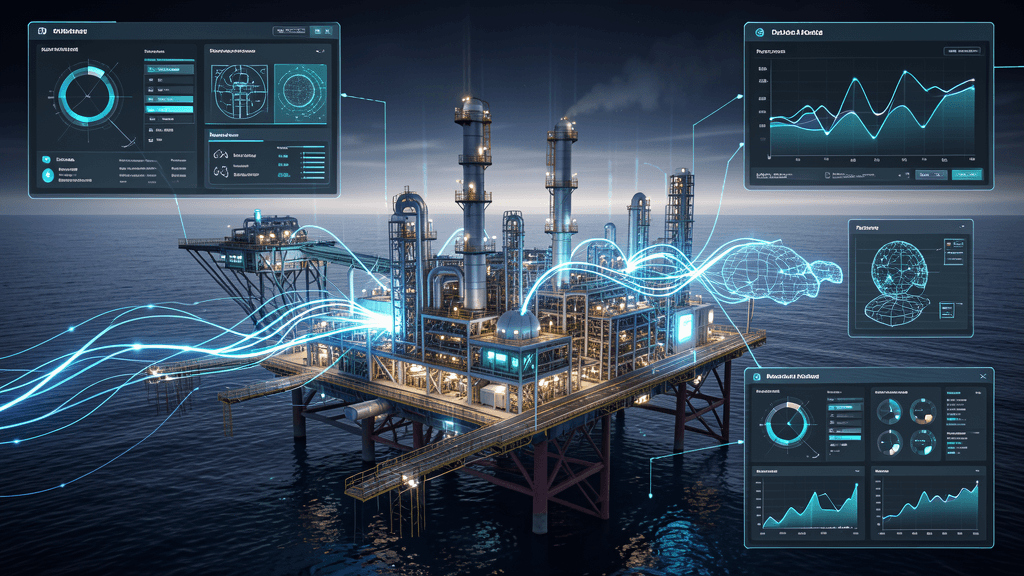
AI models that learn normal operating patterns from sensor data — vibration, temperature, pressure, flow — can flag an asset that is drifting toward failure days or weeks before it breaks. The value is not the model. The value is the avoided downtime and the extended life of expensive equipment.
For a small-to-mid-size operation, you do not need a fleet of data scientists. You need clean time-series data on your critical assets and a model with a clear trigger: "alert when this pump deviates from its normal envelope." Start with your three or four most critical machines, not all of them.
2. Production and Yield Forecasting
Operations live on forecasts — how much will we produce, when, and at what quality? Better forecasts mean better scheduling, fewer expensive surprises, and sharper commitments to customers and partners.
AI models can combine historical production, feed quality, equipment state, and external factors to predict output and yield more accurately than a simple spreadsheet trend line. Even a few percentage points of improved accuracy on a high-value stream pays for the project quickly.
3. Procurement and Supply-Chain Intelligence
This is where a small operation can get an outsized return, and it is often overlooked. Procurement in oil and gas is a game of timing and continuity. A delayed quote loses a supply slot. A missed renewal locks in a worse price. A supplier relationship walks out the door when a senior buyer retires.
An AI system can track every open quotation, request for quotation, delivery confirmation, and contract renewal — surface what is due before it is overdue, and flag aging follow-ups. It can also capture the institutional knowledge of which supplier is reliable, what discount was actually agreed, and which clause caused a dispute last year. When someone leaves, the knowledge stays.
For suppliers and service vendors, this same engine turns a chaotic list of open quotes into a clean view of the pipeline: what is outstanding, what is aging, and where to push.
4. HSE Anomaly Detection
Health, safety, and environment compliance is non-negotiable. AI can scan inspection logs, sensor readings, and incident reports to flag patterns a tired human eye would miss — a slowly rising temperature, a recurring near-miss theme, a piece of equipment overdue for its safety review.
The model is a decision-support tool, never a decision-maker. It surfaces a concern; a qualified human makes the call. That division of responsibility is exactly what keeps the AI useful and keeps the operation safe.
5. Preserving Institutional Knowledge
Oil and gas has a real demographic problem. The most experienced engineers and procurement specialists are retiring, and their knowledge lives in inboxes, spreadsheets, and their heads. AI can convert that scattered knowledge into a searchable, structured record — so a new hire can look up "how did we handle the 2023 vendor dispute" instead of asking around for two days.
This is often the lowest-risk, highest-gratitude AI project in the whole industry, because it never makes a decision. It just answers questions based on what the company already knows.
Why Most Pilots Stall
If the value is so clear, why does the pilot graveyard keep growing?
Data readiness. The data is scattered across maintenance systems, ERP, spreadsheets, and paper logs. It is messy, inconsistently labeled, and often locked in silos. A model is only as good as the data it trains on.
Vague business case. "Let's explore AI" is not a project. Without a specific, measurable outcome — reduce unplanned downtime by X percent, cut quote follow-up time by Y days — there is no way to say whether it worked.
No governance or owner. Once the pilot looks interesting, someone has to run it in production: monitor it, retrain it, handle its failures, and decide who is accountable when it is wrong. If nobody owns that, the pilot quietly dies.
Scope creep. Teams try to solve everything at once. The result is a model that does a dozen things poorly instead of one thing well.
A Realistic Rollout for a Mid-Size Operator
Do not boil the ocean. A working pattern that repeats across successful projects:
- Pick one workflow where a wrong decision is expensive and a delayed one is costlier. Good first candidates: the most critical pump, the procurement follow-up list, or production forecasting on the highest-value stream.
- Define the acceptance test before building. Write down what "good" looks like — for example, the model flags 90 percent of real anomalies with no more than two false alarms a week, or the procurement tracker surfaces every open quote before its follow-up date.
- Clean the data for that one workflow. Data readiness is the real engineering work, and it is where most projects quietly succeed or fail.
- Run a governed pilot. The model produces recommendations; a human approves every action. No external sending, no autonomous spending.
- Measure, then scale. Only after the acceptance test passes should you consider adding the next workflow. Scale is a reward for working, not a precondition.
This keeps the timeline to weeks for a single workflow, not months for a sprawling program.
What This Means for Suppliers and Service Vendors
If you sell into oil and gas, you do not need to build a rig-side AI empire. The highest-leverage move is often in your own back office — an AI-assisted sales and follow-up engine that makes sure no open quotation slips and every aging lead gets pushed. Suppliers who can show a prospective client a clean, AI-organized pipeline understand their own business better, and that confidence wins trust.
The Decision-Support Principle
Across every use case, one principle keeps AI safe and useful in this industry: AI is decision support, never the decision-maker. The model flags, forecasts, and recommends. A qualified human approves, decides, and is accountable. This is not a limitation — it is the reason a company can adopt AI without betting its licence, its safety record, or its reputation on a black box.
Key Takeaways
- The value in oil and gas AI is concentrated in a few workflows: predictive maintenance, production forecasting, procurement intelligence, HSE anomaly detection, and knowledge preservation.
- Most pilots stall on governance and data readiness, not model quality — so pick one workflow, define the acceptance test, and clean the data before you build.
- Start with your most critical assets or your highest-value stream, not the whole operation. Scale only after a pilot passes its test.
- Keep AI as decision support with human approval, never a decision-maker.
- For mid-size operators and suppliers, a small, well-governed deployment beats a broad pilot that never ships.
Continue reading: