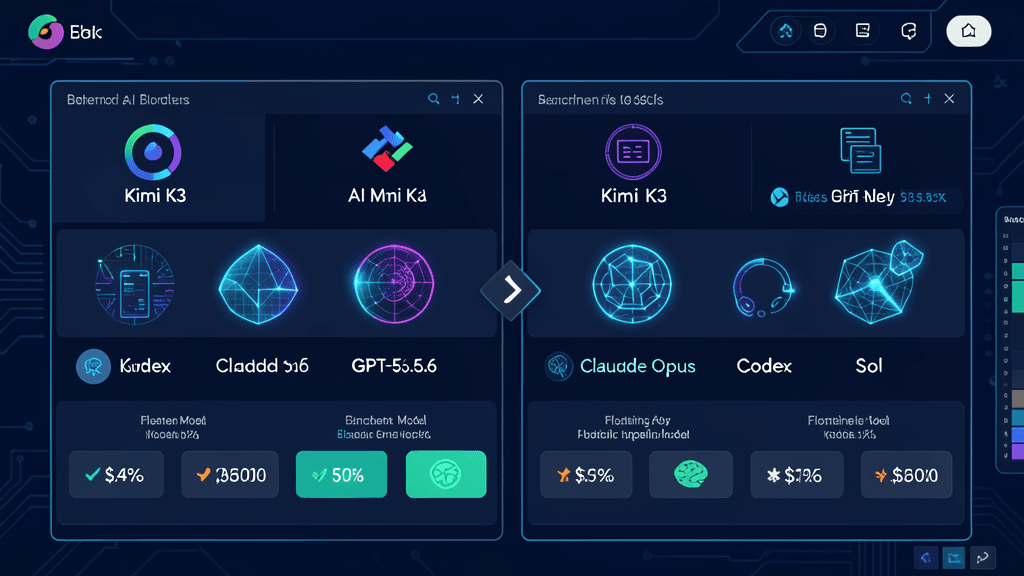
When it comes to AI-assisted web and game development, three models keep coming up in conversations: Kimi K3 from Moonshot AI, Claude Opus 4.8 from Anthropic, and Codex (powered by GPT-5.6 Sol) from OpenAI. Each claims the title of "best for developers." But which one actually delivers?
I ran them through a series of real-world tests: building responsive landing pages, creating interactive data visualizations, generating simple 3D game prototypes, and debugging existing codebases. Here's what I found — unfiltered and developer-focused.
The Head-to-Head Comparison
| Feature | Kimi K3 | Claude Opus 4.8 | Codex (GPT-5.6 Sol) | |---|---|---|---| | Parameters | 2.8T (open) | Closed | Closed | | Context Window | 1M tokens | 200K tokens | 1M tokens | | Native Vision | ✅ Yes (built-in) | ⚠️ Via plugin | ⚠️ Via API | | Cost per Token | $0.30/MTok (cache) | Higher tier-based | Various plans available | | Agent Swarm Support | Up to 100 sub-agents | Limited | Multi-file refactor only | | Best For | Rapid prototyping, vision-in-loop tasks | High-precision UI, complex architectures | React scaffolding, TypeScript | | Learning Curve | Moderate (needs clear visual feedback) | Low (very intuitive) | Medium (familiar syntax patterns) | | Local Deployment | Weights available July 2026 | Cloud only | Cloud only |
Let me break down what this actually means for your workflow.
Speed vs. Precision: The Trade-Off
Kimi K3's defining characteristic is speed. When you describe a UI concept, Kimi generates working frontend code faster than any other model I've tested. Its strength lies in converting high-level ideas into functional structure quickly.
But there's a trade-off: pixel-perfect precision. In my testing, Kimi occasionally produced small spacing errors, misaligned elements, or slight animation timing issues that required manual correction. Claude Opus 4.8 was noticeably more precise in its output — the first iteration often looked closer to production-ready. If you're building something where every pixel matters (a brand site, a design-heavy portfolio), Claude might save you time in the revision cycle even if it takes longer initially.
The sweet spot? Use Kimi to get the structure right fast, then have Claude review it for polish. Or vice versa — generate with Claude, refine with Kimi's fast iterative loop.
The Visual Edge: Why Kimi's Native Vision Matters
This is Kimi's killer advantage. Most AI coding tools operate in text-only mode: you describe a bug, the AI fixes it, you tell them whether it worked. Kimi K3's native multimodal architecture lets it see what it generated.
When I asked Kimi to fix a broken component in a generated website, it rendered a screenshot, identified exactly which element was misaligned, adjusted the CSS, and showed me the result — all without me needing to describe the visual problem in words. With Claude or Codex, I'd need to explain "the button is 5 pixels too far to the left" manually. With Kimi, I could simply say "look at this, the button alignment is off" while pointing to the actual screenshot.
For visual debugging, rapid iteration, and anything involving design, this native vision capability saves significant cognitive load. It's not just convenient — it changes how you think about interacting with an AI coding assistant.
Code Architecture: Where Claude Still Leads
While Kimi generates code faster and Claude produces it more precisely, Claude Opus 4.8 still has the edge on complex code architecture. When I gave all three models the same moderately complex task — building a full-stack authentication system with database integration, API endpoints, and frontend components — Claude's output had cleaner folder structures, better separation of concerns, and more thoughtful error handling.
Claude understands long-term codebase structure better. If you're building something beyond a prototype — something that will be maintained, extended, and scaled over months or years — Claude's architectural discipline is valuable. Kimi might produce working code that works but isn't as cleanly organized. Claude, in contrast, thinks like an engineer who knows their code will live beyond today's sprint.
The Agent Swarm Advantage: Kimi's Parallel Power
One feature unique to Kimi (in its K2.5/K3 family) is agent swarm support — the ability to orchestrate up to 100 sub-agents in parallel. This translates to real-world productivity gains for complex tasks.
Imagine generating multiple variants of a website layout simultaneously. Kimi can spin up 10 agents working on different design variations, each generating a complete version. You compare them all, pick the best, and iterate. With traditional single-agent approaches, you'd wait sequentially for one variant at a time.
This doesn't just apply to design. For larger projects — documentation generation across multiple modules, comprehensive test suite creation, cross-browser compatibility testing — the parallel execution model can reduce completion time by up to 4.5x compared to single-agent workflows.
Codex has multi-file refactoring capabilities, but it's still fundamentally a single-threaded approach (you can edit multiple files at once, but not truly in parallel agent coordination). Claude's multi-tasking is also limited to sequential workflows within a single session.
Cost Economics: Where Kimi Wins Hands Down
This is perhaps the most practical differentiator. Kimi K3 is significantly cheaper per token, especially on free or starter tiers. For hobbyist projects, indie developers, or anyone who generates a lot of code, the cost difference adds up quickly.
A rough estimate based on current pricing:
- Generating 5,000 lines of code with Kimi: approximately $2-5 on free credits
- Equivalent work with Claude: potentially $10-20+ depending on plan tier
- Codex pricing varies; standard usage falls somewhere in between
For daily coding assistants, Kimi's low cost makes frequent iteration affordable. You can experiment wildly without worrying about hitting rate limits or blowing your budget. That freedom to explore changes is itself a productivity multiplier.
Real-World Testing Scenarios
Here's how I've been using each model in practice recently:
Quick Landing Page / MVP Prototype → Kimi K3
- Prompt: "Create a dark-themed SaaS landing page with scroll animations, contact form, and hero video background"
- Outcome: Working HTML/CSS/JS in under 5 minutes. Minor spacing tweaks needed, but fully functional.
- Why Kimi? Fast iteration, visual feedback loop, lower cost
Brand-Focused Portfolio Site → Claude Opus 4.8
- Prompt: "Build a personal portfolio site with exact matching to this Figma design reference, including micro-interactions and smooth transitions"
- Outcome: Pixel-perfect first iteration near-final result. Minimal fine-tuning needed.
- Why Claude? Precision, attention to detail, strong visual interpretation of design references
React Component Library / TypeScript Project → Codex (GPT-5.6 Sol)
- Prompt: "Create a reusable React component library with TypeScript types, prop validation, and Storybook documentation for each component"
- Outcome: Well-organized folder structure, clean type definitions, consistent patterns throughout.
- Why Codex? Familiarity with React patterns, strong TypeScript understanding, industry-standard code organization
Debugging Existing Code → Mixed Approach
- I typically start with Claude for diagnosis (understands codebase well), implement with Kimi (fast edits and iteration), then verify with Claude again. The hybrid workflow combines Claude's reasoning depth with Kimi's speed.
Which One Should You Choose?
There's no single "best" model. The right choice depends on your specific needs:
Choose Kimi K3 if:
- You value speed over absolute precision
- You want visual feedback loop (screenshot-based iteration)
- You're on a tight budget or using free credits frequently
- You need agent swarm/parallel task capabilities
- Your projects are shorter-lived, experimental, or prototype-focused
Choose Claude Opus 4.8 if:
- Pixel-perfect UI accuracy is critical
- You're building maintainable long-term architecture
- You prefer a more deliberate, slower pace with higher quality per-output
- You want deep contextual understanding of complex codebases
Choose Codex (GPT-5.6 Sol) if:
- Your primary stack is React/TypeScript/JavaScript
- You're maintaining an existing codebase familiar with its patterns
- You value industry-standard code organization and conventions
The Future Is Hybrid
Looking ahead, the most effective workflow may not be choosing one model exclusively. Many developers I've spoken with are starting to adopt hybrid approaches:
- Ideate & Structure with Kimi — rapid visualization of concepts, quick wireframe generation
- Refine & Polish with Claude — careful review of UI details, final polish pass
- Implement Patterns with Codex — writing familiar React/component patterns
- Review & Test Together — running tests, checking accessibility, validating cross-browser behavior
This isn't about replacing human judgment — it's about amplifying it with the right tool for each phase of the development cycle. As each model continues to improve, these boundaries will blur further. But for now, knowing their individual strengths gives you a strategic advantage.
And regardless of which model you choose, remember this: none of them replace the need for a developer who understands why code works, not just how to make it work. These tools excel at implementation and iteration — they don't yet excel at architectural strategy, user empathy, or the nuanced decision-making that defines great engineering.
Use them to handle the tedious parts. Keep the big decisions in your hands. That's where the real value lies.